
How to trim the sails on a cruising catamaran
Sail trim on a catamaran comes down to reading the airflow over two sails and adjusting a handful of controls. This guide covers the mainsail and genoa: what each control does, what the telltales are telling you, and what to change.
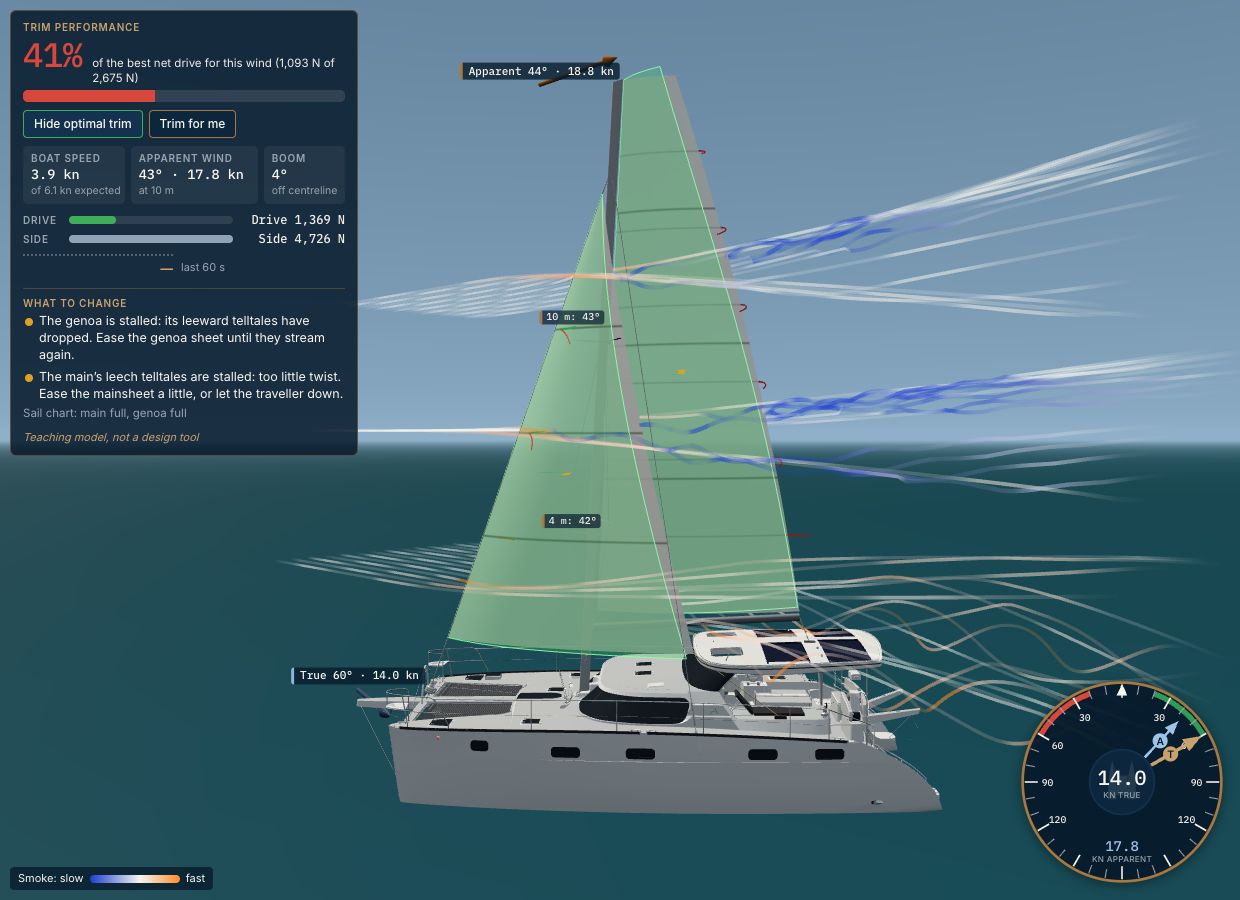
A catamaran gives you less feedback than a monohull. It barely heels, the helm stays light, and a badly trimmed sail does not announce itself. That makes the telltales and a clear picture of each control more important. Every point below can be tried in the Antares 44 sail trim trainer, a free interactive 3D model that shows the airflow and telltales responding as you move each control.
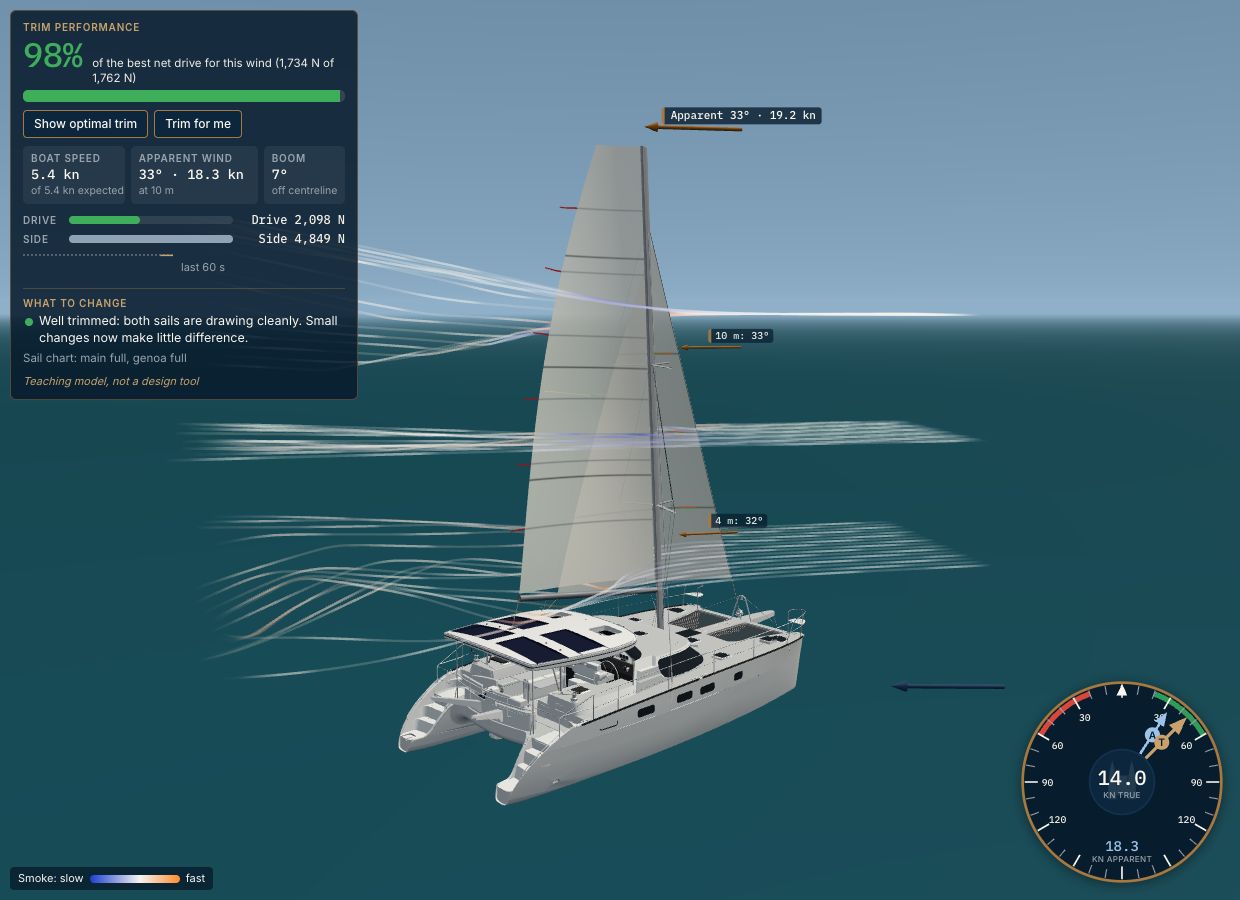
1. Read the genoa telltales
The telltales near the genoa’s luff show whether air is flowing cleanly over both sides of the sail. There is one set on the windward side and one on the leeward side.
Windward telltales lifting: the sail is under-trimmed. Sheet in.
Leeward telltales drooping or spinning: the sail is over-sheeted and the flow has separated. Ease.
The genoa is trimmed when both sets stream straight aft. A reliable routine is to sheet in until the leeward telltales just start to stall, then ease a touch.
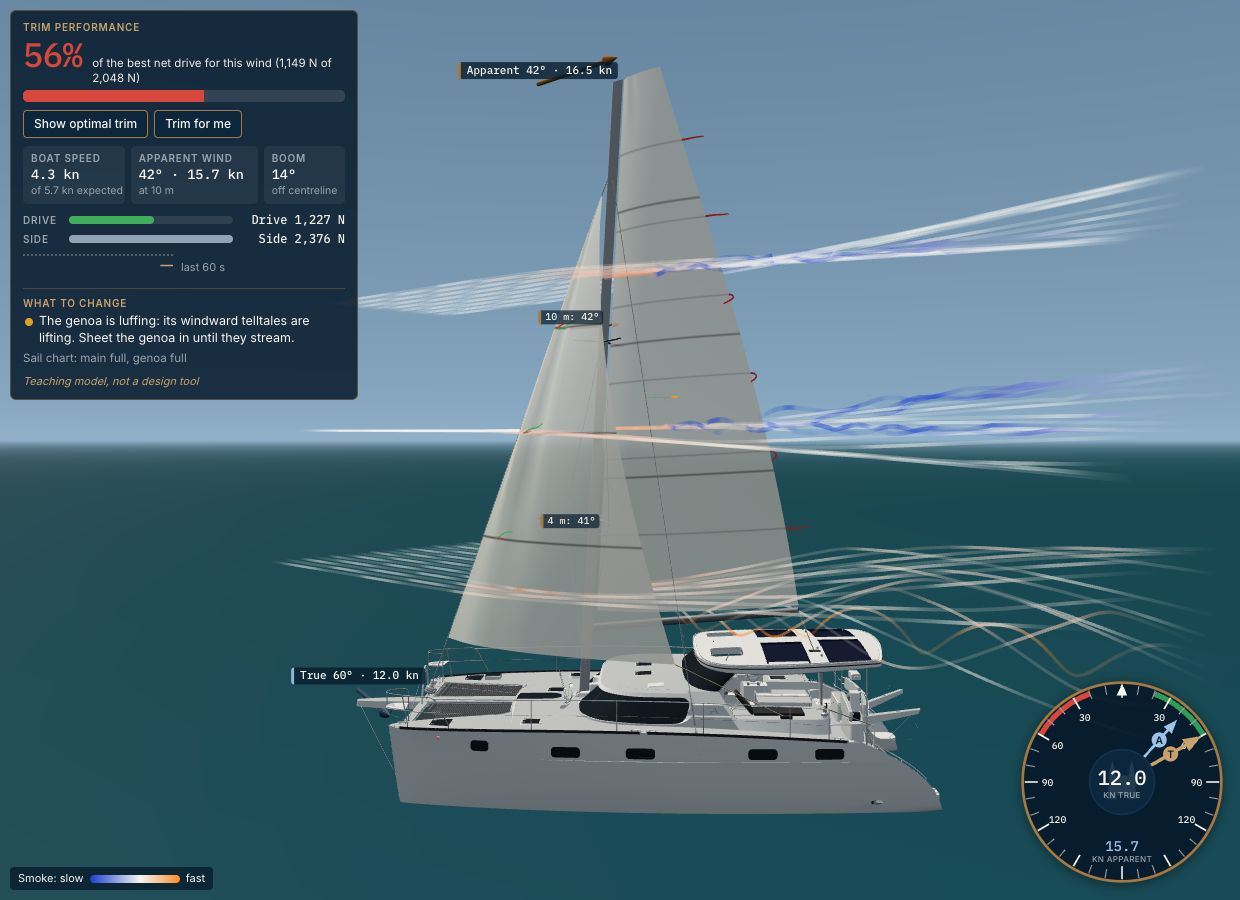
2. Use the genoa car to set twist
The sheet sets how far in the sail is. The car, the block the sheet leads through on its track, sets how the pull is shared between the foot and the leech, and that decides how much the top of the sail twists away from the wind.
With the car aft, the sheet pulls along the foot and lets the leech rise, so the top of the genoa twists open and luffs first. Moving the car forward pulls down on the leech and closes the top. The car is right when the telltales break evenly from top to bottom as you slowly ease the sheet or head up. Some twist is correct: the wind blows from further aft higher up the mast, so the top of the sail should be a little more open than the bottom.
3. Mainsheet for twist, traveller for angle
Upwind, the mainsheet and the traveller do two different jobs, and mixing them up is the most common mainsail trim mistake.
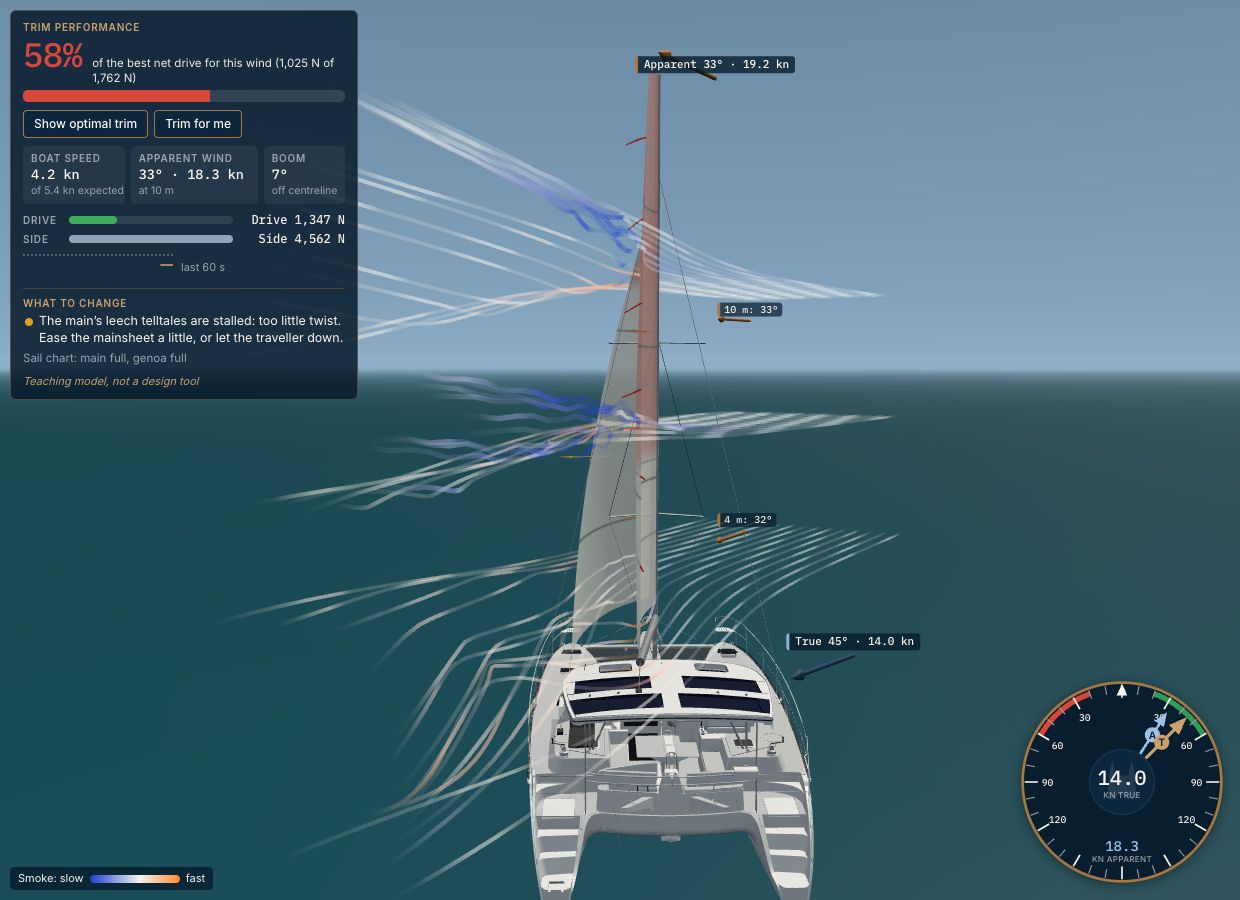
The mainsheet mostly pulls the boom down. That tensions the leech and controls twist. Sheet too hard and the leech closes, the top of the sail stalls and the leech telltales stop streaming. Ease too far and the top twists open and stops working.
The traveller moves the whole sail in or out without changing its shape. Catamarans have a wide traveller for exactly this reason. Set the twist with the mainsheet until the leech telltales stream, with the top one just starting to flick, then use the traveller to set the sail’s angle to the wind.
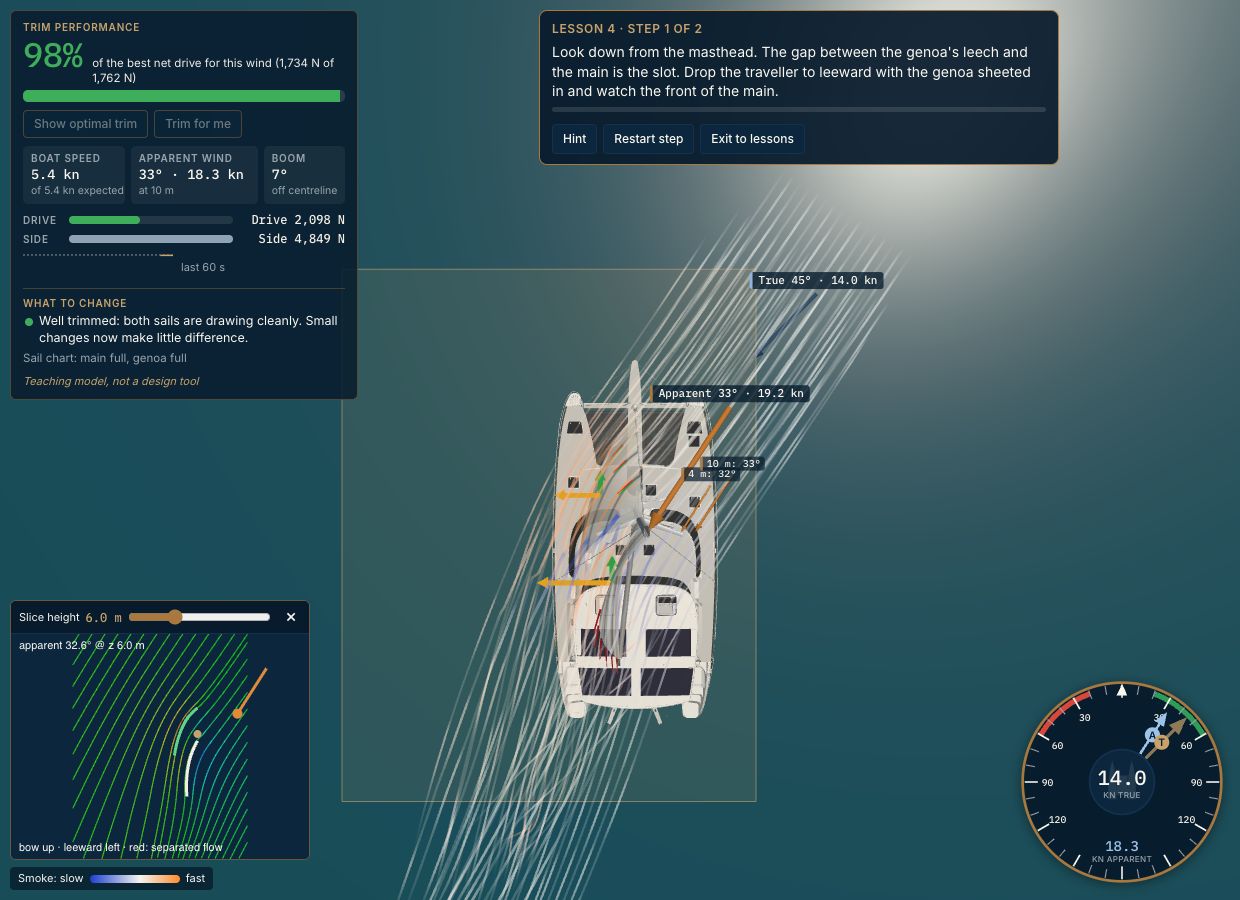
4. Mind the slot
The gap between the genoa’s leech and the lee side of the main is the slot. Air accelerating through it is a large part of why two sails together make more drive than the same two sails apart.
Choke the slot and both sails suffer. An over-sheeted genoa dumps disturbed air onto the main and the front of the main lifts or backwinds. A main dropped too far to leeward, close behind the genoa’s leech, does the same from the other side. If the luff of the main is backwinded, pull the traveller up a little or ease the genoa a touch.
5. The vang: when it matters and when it does nothing
Close-hauled, the mainsheet is already holding the boom down harder than the vang can pull, so the vang does nothing. It becomes the twist control on a reach. Once the boom is eased past the end of the traveller, the mainsheet pulls it sideways more than down, the boom lifts and the top of the main twists right off. Vang tension brings the leech back.
It has a right amount. Too little and the top of the sail is wasted. Too much and the leech closes and the top stalls. Add vang until the leech telltales stream, then stop.
6. Depower as the wind builds
As the wind rises, drive grows but side force grows faster. On a catamaran that shows up as load and leeway, not heel. Before reefing, depower in this order:
Twist first: ease the mainsheet a little so the top of the main opens and stops working.
Then traveller down: drop the traveller to leeward to reduce the angle of the whole sail.
That lowers the centre of effort and sheds side force while keeping most of the drive.
7. Reef by the numbers
Because a catamaran does not heel to warn you, reef by true wind speed and angle using the builder’s sail chart, and do it early. Reefing takes area off high up, so side force and loads fall more than drive does. After reefing, retrim: the smaller sails want different sheet and traveller settings from the full ones.
8. Know when main and genoa are the wrong sails
Trim cannot fix the wrong sail. In light air off the wind, a genoa is too small and too flat, and the sail chart will call for a screecher or an asymmetric spinnaker. Catamaran shrouds are also swept well aft, so on a broad reach the main meets the leeward shroud before it can be eased far enough, and it stalls. Sailing a slightly hotter angle with a bigger headsail is usually faster than running deep under main and genoa.
Try it yourself. The Antares 44 sail trim trainer shows all of this live in 3D: smoke trails for the airflow, telltales that lift and stall, a bar that shows how close you are to the best trim, and eight short guided lessons. It is built on the Antares 44’s real sail plan, rig dimensions and polars.
Common questions
How do I know if my genoa is trimmed correctly?
Watch the telltales near the luff. When the windward and leeward telltales both stream straight aft, air is flowing cleanly over both sides of the sail and the genoa is trimmed. If the windward telltales lift, sheet in. If the leeward telltales droop or spin, ease the sheet.
How do I know if my genoa is over-sheeted?
The leeward telltales stop streaming and hang or spin, because the airflow has separated from the back of the sail. Ease the sheet until they stream again. An over-sheeted genoa also closes the slot and can backwind the front of the mainsail.
What is the difference between the mainsheet and the traveller?
Upwind, the mainsheet mostly pulls the boom down, so it controls leech tension and twist. The traveller moves the whole sail in or out without changing its twist, so it controls the sail’s angle to the wind. Set twist with the mainsheet, then set angle with the traveller.
Does a catamaran need a vang?
Many cruising catamarans rely on a wide traveller instead. Where a vang is fitted, it matters on a reach: once the boom is eased past the end of the traveller, the mainsheet no longer holds the boom down, the boom lifts and the top of the main twists open. The vang takes over leech tension there. Close-hauled, the mainsheet is already holding the boom down and the vang does nothing.
How do I depower a catamaran when the wind builds?
First ease the mainsheet a little to let the top of the main twist open, then drop the traveller to leeward. That sheds side force and load while keeping most of the drive. If the boat is still overpowered, reef.
When should I reef a cruising catamaran?
Reef by the numbers, not by feel. A catamaran does not heel much, so it gives little warning that it is overpowered. Follow the builder’s sail chart for the true wind speed and angle you are sailing, and reef early. After reefing, retrim: the smaller sails want different sheet and traveller settings.
Why does my mainsail stall when I am sailing downwind on a catamaran?
Catamaran shrouds are swept well aft, so the boom and sail can only go out until they meet the leeward shroud. On a broad reach the wind is further aft than the sail can follow, and the main stalls. Heading up a little, or changing to a larger headsail and sailing hotter angles, brings the flow back.